All Is Well — Under the Grace of Consciousness
The night before, something subtle had already begun. As I lay resting, I kept catching brief glimpses of a Devi form adorned with the crescent moon—never steady, never fully clear, just passing flashes that appeared and disappeared. The vision did not stay long enough to understand, yet the impression lingered quietly with me through the night and into the morning. At the time I simply noted it and moved on.
For several days I had been unable to resume my work on Tripura Rahasya. My mind had been absorbed in a question that would not leave me: what is the nature of consciousness? I felt that before returning to the screenplay I needed to understand something more deeply.
Then this morning unfolded.
My wife mentioned that our daughter, traveling in Greece, had lost her Mercury ring. It was already the second time such a ring had gone missing, and naturally people in both the United States and India began discussing how another one might be obtained.
About twenty minutes later, just before going for my bath, I asked my wife to arrange a small gathering to chant the Lalitha Sahasranamam in connection with my upcoming Shakti Peetha pilgrimage. During that same conversation I repeated something I often tell her—that reality is not fixed, that what seems unquestionably true today may appear differently tomorrow because consciousness itself continuously shapes the unfolding of life.
By then the ring incident had already faded from my mind.
I proceeded with my morning puja centered on the Sri Chakra. Flowers—hibiscus, roses, and wild jasmine—were offered. The invocations followed in their usual order: Ganesha, the planetary forces, the directions, the serpents, and the Divine Mothers Saraswati, Lakshmi, and Katyayani.
The worship of the sixty-four Devis of the Sri Chakra was completed, along with japa—Ganesha mantra, Gayatri mantra, Shri Mata mantra, and the nineteen-lettered mantra. After the offerings and a prayer for forgiveness, I entered meditation, gradually withdrawing attention from the senses, the body, and even the stream of thought.
Then something unexpected occurred.
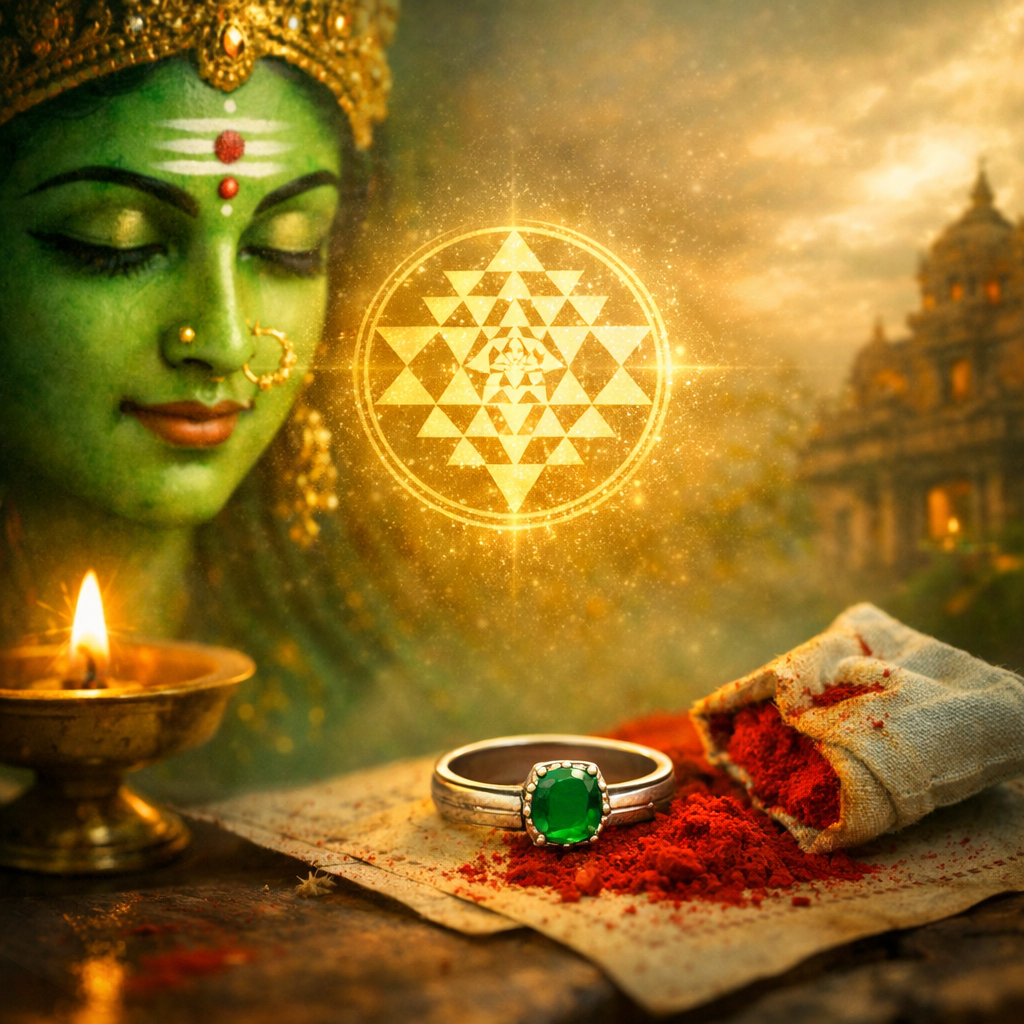
From what seemed like a seed-like point, a form arose in awareness—a green Shakti, marked with tripundra. The emergence was vivid enough to bring me out of meditation. I completed the puja with full prostration and continued with the morning routine, including sitar practice.
Some time later my wife told me that our daughter had found the ring in her purse, in the same place she had searched several times before.
Only afterward did another realization arise. The Devi who appeared in meditation resembled Matangi, one of the Dasa Mahavidya, traditionally associated with the color green and with the refinement of intelligence and expression. In that moment, even the fleeting crescent-crowned glimpses from the previous night suddenly made sense. The connection with Mercury—the planet symbolized by the ring—became immediately clear.
Then yet another coincidence emerged: the day itself was Navami, the ninth day, and Matangi is traditionally regarded as the ninth Mahavidya, with Kamala completing the sequence as the tenth.
Later in the day, while clearing the loft, I came across several old packets of prasad that had been brought from India years earlier—sacred ash and kumkum. One packet stood out: kumkum from a special Matangi puja performed two years ago, which had somehow never been retrieved or worn as tilak.
Seen individually, each event was ordinary:
a ring misplaced and later found,
a meditation image,
a forgotten packet rediscovered.
Yet when viewed together, the day quietly arranged itself into a meaningful sequence:
a Mercury ring lost,
a green Devi appearing in meditation,
the ring found again,
Matangi remembered through an old offering,
all on Navami—the ninth day—linked with the ninth Mahavidya.
Nothing here points to the supernatural. Instead it gently reminds us that reality itself is not fixed. Consciousness—true to its nature—is aware of time, place, intention, need, and circumstance. It moves through life with a kind of quiet intelligence and empathy, arranging moments so meaning becomes visible.
When such moments occur, they leave behind a simple reassurance:
All is well.
And all can be well—under the grace of consciousness.